Wednesday, 15 October 2014

The Utsav – It’s Diwali time

The festival of lights is just a few weeks away from us. The fireflies flit around lighting up the darkness, knowing very soon that they will be joined by thousands of sparkles and sparks lighting up the skies. The colors of the season – bright and fluorescent – lend their charm to the season. The artisan, who works with Banna’s inhouse team knows very well that these threads will be an essential part of the season today.

The magic of Tussar and the richness of the fabric create a beautiful base for these exquisitely embroidered sarees and dupattas.

Sun flame offset with shocking pink in Tussar


A bright yellow color, which seems like it has borrowed a wee bit of color from the majestic Sun is offset with a shocking pink pallav. The motifs reflect the image of the Sun. No surprises why ‘she’ looks stunningly royal. And that ‘she’ could be ‘you’!

Black and pink Tussar saree

Black has many shades. And, if you have seen twilight hour, it’s beautiful. The quietness is so awesome that the whole place seems mesmerizing. That’s the color this saree assumes. And, offset with a shocking pink, with bold gold wide borders running along the length of the pallav.


Black and Turqoise Tussar saree


Stunning and stylish, the turquoise is all grandeur. It’s so beautiful a color that it lends the wearer a character, as she drapes it around herself and shows off the most lovely pallav. The temple weaves add their own aura. Best to be worn if you have a wedding to attend during the festive season

Green and Red Tussar saree


This saree takes its colors from the parrot in your guava tree. The green body offset by a lovely red, with buttas strewn all over…This is a lovely ensemble and provides a rich look and feel

Mustard  Tussar with a touch of Black


This design is elegance personified. Mostly yellow with broad borders, it gives the appearance of a half saree. The eloquent gold patterns bring out the richness of the motifs. As you graciously carry yourself wearing this lovely ensemble, you are sure to hear this – Is that lovely woman really you?

To buy these beautiful pieces click here: 

http://www.bannacreations.com/tussar-silk/39

Call us on 9945611081; or mail bannacreations@gmail.com for details. 

Thursday, 2 October 2014

The Banna Dasara Collection : For Puja or to Play Garba !!!!


For Puja or to play Garba, colors, silks and jewellery seem to be just the right ingredients.  Be it the dazzling brightness of the October Sun or the colors of the shy Sunset, we’ve captured them all through various prints and weaves. Vivid, bright, blocks, gold, design – all these elements are woven into our designs for sarees and dupattas. Splashes of pink, maroon, orange, brown, black in lovely and bold designs give the ensemble just the right look for a great evening.

As the festivities begin, the drums beat, the music reverberates…design acquires another meaning. Interestingly, colors form the very basis of this festival – the triumph of good over evil. As you check out the sweets, traditionally prepared or the fine threads that go into the making of sarees, dupattas, shirts, skirts, blouses and so on, spare a thought for the artisans who have worked, investing their imagination and excitement into these products. Each product comes to you with Banna’s special touch – the colors, designs and the same aura that we fuse to ‘handcraft your style’.  All products have received the finishing touch – from tassles, finishing embroidery, picco, hemming (to name a few) - from Banna’s sustainability programs.


We have also brought a vast array of tribal jewellery – from bell drops, rings, beads, loops – all crafted in using brass, copper and silver, to produce that special effect. Rustic glamor! That’s it. Mix and match, choose the right accessory to go with your special Dusshera wear.

Some hightlights from the collection : 

SILK KOTA SAREES - This midnight blue-black silk kota saree with its bold mustard and green motifs is as attractive as it get. The motifs are clearly attractive drawing attention to the bold design. If it is kota, it has to be bold! Right lady?

And, when the weavers sat down to a wholesome mean of Indian bread and vegetables, they recalled their stories heard from their childhood. The  Kota sarees, popularly known as 'Masuria' in Kota and Kotadoria outside the state draw their word thread from 'Doria', which means thread.  Seeing how attractive this has been, the many co-operatives are helping the weavers produce items other than sarees from Kota Doria – such as lamp shades, curtains, skirts and salwar-kamiz.  As for the Kota saris, they display individuality with a bit of embroidery and border patches, making them totally exclusive.

To view or buy the collection click here:

 http://www.bannacreations.com/kota/82

TUSSAR RAW SILK SAREES - 
The most unusual of colors make a striking rhapsody! Today, it is the age of ‘make locally, sell global’. Beige, with yellow and a shocking pink appearance give the saree a special hue.

So, what! It’s Dussehra time. It’s time to bring out your sweet recipes, do your shopping and begin the festive preparations for the festival. The artisan has borrowed from the colors of the festival – the brilliance of yellow, the maturity of beige and the shock effect of that pink. Sitting cross-legged, recalling stories told by the grandmas and grand aunts, the artisan family agree to try out new colors. Let’s go bold, appears to be the theme of this saree.

To buy the collection click here: 

http://www.bannacreations.com/tussar-silk/39

THE MADHUBANI CHANDERI COLLECTION - 

Madhunbani Chanderi black dupatta

It’s midnight black. And, black is beautiful. So, when can you wear it? At a Dusserha party in the evening, where you get to show off the lovely madhubani border.

Chanderi is light and lovely. The colors are bold and brilliant. When the artisan decides to combine different art forms, it is also because he is actually trying to share his knowledge. It’s his creativity that he expresses as he brings out his art skills in trying out the most intricate design border on a midnight black body.

To buy click here: http://www.bannacreations.com/home/black-chanderi-cotton-silk-dupatta-with-madhubani-four-side-border-/451.html

Orange chanderi rhapsody

The orange is more orange than the fruit you can get from the best orchard. You need to be bold and charming to carry it off! Walk into a party and check the pulse! Watch the heads turn….
The colors of flame, the colors of orange and the colors of a passionate flame – that’s the color of ‘orange’. It can appear to be tempestuous when it wants and attractive when it desires. As the artisan sat down to introduce those threads, it may have been a reflection of his excitement. His exchanges from his mind and reflections to action reflect this passion. When you wear a handwoven dress or a saree, or a dupatta, stop to feel the fabric. Take a deep breath and bless those hands that translated his or her dreams into that ensemble.

To buy click here: http://www.bannacreations.com/madhubani/orange-chanderi-cotton-silk-dupatta-with-madhubani-border-/448.html

To view Banna's Entire collection visit: http://www.bannacreations.com/dasara/157

When you buy a Banna product, you are also investing in the dreams and aspirations of the artisans who have been working hard to get you these lovely products on time!


Saturday, 26 July 2014

New Designs from the Banna Beadbox

Banna creations has a large variety of bead box jewellery, all of which is hand made tribal jewellery. The items are beautiful and unique in their own form and consist of a variety of colours and styles of earrings and necklaces.

The earring collection is vast and contains a wide variety of colours. A number of them  are gold or silver and have beads hanging from them in different colours and styles. Others consist of drops in a variety of colours as the main content of the earrings, with patterned detail on them or other details such as beads added below the drops - such as the coral and amethyst drops as described below.

Some that Stand out are the hooped earrings with colours hanging from them - such as the hoops in purple and blue as described below: 

Water Crystals in white

These are a beautiful pair of earrings  and transparent white in colour. They feature a bead, above and below the crystals, which adds detail to the item. These simple earrings would be suitable for all occasions and events.

Hoops in purple and blue

As noted above, many of the items follow a similar design to this item. This is a beautiful  and unique design, which will compliment your outfits well. The use of different colours for different designs of hoops will not leave you short on choice.

These hoops have a silver twist overlaying the main hoop, with 7 drops hanging from them featuring beads in blue and crystals in purple.


Coral and amethyst drops

The coral drop earrings features indented detail and patterns, this includes flowers and leaves. The amethyst beads above and below the coral drop add a sense of sophistication and catch the eyes when reflecting the light. These earrings are an eye catching piece


Rose studs - Mauve

These are a simple, yet beautiful pair of earrings. Particular attention to detail has been paid here to create this rose, which makes it look really due to the high quality.


Cascade in blue - double ring

Cascade is a waterfall. This is well represented by these earrings, with the double ring representing the stages off the waterfall, falling from one step to another and getting typically wider the further down the waterfall. The contrasting beads of light blue and dark blue clearly represent the water and it's different colours, as seen in a waterfall. These earrings are a very unique pair and have a great appeal to the eye.


Drops of blue

These are an appealing pair of earrings, with a silver tear dropped body and sea blue crystals around the edge of the body. These are once again a very unique pair of earrings that appeal to the eye


Black and red crystals with pearl drops

Personally I love these earrings, the red crystals are subtle amongst the black and they sparkle when reflecting the light. The bigger pearl drops contrast well with the black and red colour and add extra detail to the design making them even more beautiful to look at.


White beauty and gold

Two white crystals separated by gold detail. The lower crystal features patterned detail to make it look like a leaf, whereas the upper crystal is plain, with a white centre. 

In addition necklaces are also available. These, once again come in a variety of colours and designs. The majority feature crystals or beads and come with or without pendants. Pendants are also available separately if you feel you would like one with your necklace.


Blue - Green round pendant

This is a personal favourite. Larger purple and green crystals are mixed upon the purple crystals with a few green crystals too, silver beads are also used throughout,which adds appeals to the necklace. The pendent is round and features beautiful detail which catches the eye,  this is in the form or spirals to form a circle from a centre point and subtle hearts around the edge.


Green and red Crystal with brown Ceramic beads

Green Crystals form the majority off this necklace with a bigger red Crystal placed on either side, near the top and at the bottom. The brown Ceramic beads add further detail to the design and feature darker lines vertically around the beads.


Red Crystals with blue ceramic beads

This is one of the simpler necklaces with red crystals separated by a silver bead after every 7th red crystal. Towards the bottom of the necklace there are blue ceramic beads, equally spaced out. These feature lighter blue patterns, which add detail to the necklace and catch the eye.


Pink and pearl necklace

This is a simple and sophisticated necklace, predominately with pink beads. This necklace also features pearl and silver beads which add appeal and detail to the item.


Doughnut pendent and black bead chain

This beautiful detailed necklace features black beads with red tear drop shaped beads interlinked throughout. Silver beads also add and create appeal for this beautiful necklace and contrast well with the doughnut pendent. The pendent consists of a small detailed circle in the centre, surrounded by a number of circles, each getting bigger in size. Two of the layers lay above the rest with bigger detail than the surrounding layers.

The necklaces and earrings available at  Banna Creations’ Monsoon Beadbox Collection  are all of high quality and hand-made. They consist of a variety of colours and styles, which have been carefully put together to create a range of jewellery that will meet the needs of many through the careful thought and creativity taken during production, which ensures the beauty of these products. 


Friday, 25 July 2014

Launching !!! A Special Range of festive Dupatta's...

The new range of cotton silk dupattas - Chanderi and hand woven cotton silk  from Banna Creations are produced to the highest quality and are hand-made by Artisans throughout India. In addition to being the hand work of artisans from various parts of the country, these dupatta's are also worked on and finished by the ladies from our sustaible livelihoods programme they work on the finishing of these Dupattas with tassels, hemming and final completion. 

 The high quality, thought and care taken into each individual Dupatta always assures each is produced to the finest standard. This is done through sourcing fabrics, stitching and designs from a diverse range of places around India.

All designs are Banna's own with the dyeing, block printing and embroidery being done by our artisan partners. 

The ladies from the sustainable livelihoods programme have created tassels of their choice to match the Dupattas. Therefore a variety of size, colours and innovative designs have been used to finish the Dupattas, adding an extra appeal to them.

Some highlights of the collection:


This beautiful cotton silk Dupatta features the 7 colours of the rainbow, and is very unique and eye catching. Each colour section is skilfully joined together to look like 1. The circular detail,  which is shown within the perimeter of each colour, adds simple detail and compliments the Dupatta and adds a uniqueness and appeal to the design. The long tassels in alternative light blue, purple and navy blue with gold detail at the top add a simple additional appeal to the Dupatta. The tassels contrasts well with the colours of the rainbow, in order to not overpower the Dupatta. This Dupatta would compliment a simple and plain outfit.

In contrast to the above Dupatta, this white Chanderi cotton silk Dupatta is very light and would compliment a colourful or simple outfit to provide a beautiful finish to any outfit. It features a subtle gold detail border and Embroidered circles which may represent eternity and  diversity  through the variety of colours used, which link together from one to another, representing that everything continues: green, blue, yellow and red. In addition to this the shorter tassels in blue, red and yellow contrast well with the coloured stitched circles, white material and the gold border and bring a greater appeal and create a unique elegant and simple Dupatta.

This beautiful Chanderi cotton silk Dupatta displays a gentle, relaxing contrast from blue to green. The blue  represents the sea, and the green represents the land. The gold leaf shaped detail adds a sense of life is anywhere - in the sea or on the land. In addition to this, this Dupatta features a gold border around the edge and gold tassels. These delicate tassels have a bead inserted at the top. There is a high density of these tassels along the Dupatta  to give it a flowing effect. 

Another Dupatta features the same idea of the contrast and change in colour progressively throughout the Dupatta. This changes from light green to dark green, once again with a gold border. The tassels match the darkest shade of green and compliment the Dupatta well, especially against the lightest shade of green. Gold detail is also added to the top of the tassels, which adds an extra aspect of creativity and catch the eye.


This Dupatta in Chanderi Cotton silk  is darker than the others and features a black, red, black pattern, a gold border is once again seen and adds appeal and detail to this Dupatta. The stages between the sections are sudden, but not straight lines, which may represent that things change at different times for different people;  This Dupatta also suggests that although there may be dark and bad occurrences in life, if you have hope and love things will improve. The black tassels contrast well with the design.


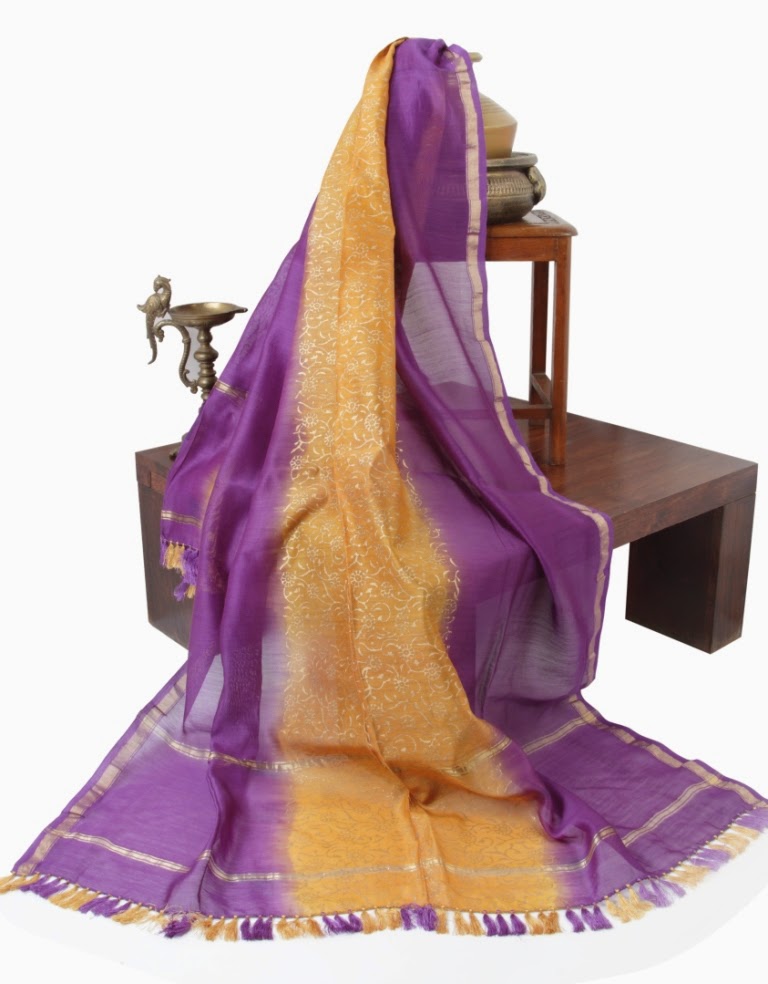
This is an eye catching beautiful Dupatta and stands out amongst others. There is a contrast in patterns between purple and mustard with a smudged effect at the boundaries of the mustard section. The Mustard features a gold sparkled pattern overlaying the base, with detailed patterns representing flowers and leaves. Again there is a gold border and the tassels here feature the colours gold and purple in alternative groups of 3 adding an extra appeal.


This magenta  coloured Dupatta is at first glance simple, but a look closer reveals green, yellow and blue embroidery detail, which contrasts well with the magenta background. The green detail forms the leaves and plant for the yellow flower to be placed above. The embroidery used is Kamal Kadai... Just the right number of flowers with the right amount of Appeal 


The subtle change in colour from blue to green creates a simple Dupatta and is difficult to see this change at first. However, the tassels on this Dupatta make the contrast more noticeable, due to their light blue colour which contrasts with, and emphasises the colours used. Simple and elegant Chanderi Cotton Silk 


This orange to pink  Dupatta is once again beautiful and is emphasised by the gold tassels and gold details. The gold details features the gold border and what is a bold Gold block print on the orange section. The change to Pink  is only at the edges if the Dupatta, near to the gold tassels. This adds a simple extra detail to the Dupatta and is effective to create an extra appeal to the design.


Here is another Rainbow themed Dupatta in Cotton Silk with Each colour Patch seamlessly coming together. .. 
The Kantha embroidery is done in Self colours to add that touch of subtlety and the central strip has a block kantha motif .... 


The Collection also features a very special set of Kantha embroidered chanderi Cotton silk dupattas. The light and subtle white piece with bold blue peacock embroidered using kantha techniques
The lovely Orange and the bold black. The orange piece has a closely embroidered Border design and the black one has a bold flaming flower embroidered on either side ! 


All pieces from this collection will be available for purchase online on our website from monday the 28th of July. Also can be purchased directly at our upcoming exhibition on the 1st and 2nd of August. 
Log on to www.bannacreations.com for more details or visit our facebook page... 


Thursday, 30 January 2014

Hand Embroidery in India- An art that weaves India into one

An art is a form of self-expression and when that is combined with sheer hard work and patience what comes out is a pure reflection of the artist’s aspirations, hidden desires and beliefs. Hand Embroidery can be one of the best examples of one such art that dates right back to the Iron Age where the seeds of the first forms of such an art were sown. With the new and advanced civilizations Embroidery as an art was given due recognition and it spread across various parts of the globe like Egypt, Babylon, Spain, Sicily and other European countries. Each country has its own unique style of embroidery depicting their history, cultures and traditions. India too been a part of this rich art. Thanks to Indias Cultural Diversity where a total of more than 500 languages exist it is difficult to comprehend the depth and richness of art that is present in Modern Day India. Spanning across the country  from Rajasthan to Bengal, Kashmir to Karnataka , Kerala and Andhra, Gujrat to the North East  hand embroidery in India has evolved in multifaceted forms. Phulkari Embroidery, Kantha, Kathi, Rabari, Chikankari, Kashmiri, Kasuthi -  the list is endless. Each one has a story of its own..


Kantha Embroidery of Bengal is famous for its embroidered quilts. Kantha itself means patched or quilted cloth. It involves simple running stitch. Multiple layers of cloth are stitched together which are generally made of old saris, dhotis and other precious silks and muslins. Kantha is used for multiple purposes like quilts, shawl, pillow covers, handkerchiefs, book covers and even toilet accessories. The process of recycling unused clothes and turning it into an artistic good is an art by itself. Artists design various motifs which can be form of god, goddesses, flowers, animals and other geometric patterns. Depending on the form of product Kantha is further subdivided into various other forms such as Oaar kantha for pillow covers, Lep Kantha for quilts and Rumal Kantha for handkerchiefs and so on. While Kantha embroidery Orginated in Bengal , different forms of Kantha embroidery are also practised in Several states of the North East especially Assam. While the essence and techniques remain the same , there are subtle differences in these diverse forms from different states.

Kutch Embroidery is another famous form of art in Gujarat. The embroidery is done on every day attire and other Objects of Everyday use. These include traditional dresses, blankets, quilts and even covers for animal backs, horns and forehead. The striking feature of this embroidery are the  colourful designs. Popular colours include green, purple, yellow, saffron, white. The embroidery also has a certain Degree of Grandeur by the use of tiny mirrors in various shapes and sizes. Chain and open stitch is often used to give it a precise appearance.

Chikankari is native to the capital city of Uttar Pradesh i.e Lucknow. The word Chikankari comes from the Persian word Chakeen which means intricate patterns made on fabric. It is believed to be introduced first by Emperor  Jahangir’s wife and is still one of the most famous decoration styles in Lucknow. It is a white thread embroidery done on a variety of fabrics such as silk, net, muslin etc. The typical process of Chikankari includes Designing, Engraving, Block Printing, Embroidery, Washing and finishing. The patterns and designs are created using different types of stitches and thickness of threads. In  total there are about 36 different types of stitches.

Kasuti Embroidery is a form of embroidery practiced in Karnataka especially North Karnataka . It’s name is derived from the words Kai and Suti meaning hand and cotton. The Kasuti work is very intricate involving more than a thousand stitches by hand. The handicrafts development cooperation of Karnataka holds a GI for the protection of this art form. Kasuti is found in a variety of Ilkal saris –Both Silk and Cotton.
Sujni Embroidery is a traditional to Bihar. It is usually made by stitching new cloth over various old layers of cloth. The embroidery includes flowers, birds, creepers and sakhi designs. The main Stitch here like Kantha is the running Stitch. Products includes quilts, bed sheets , jackets etc.

Sozni Embroidery is another traditional art form of Kashmir. Kashmir is famous for its delicate and precise embroidery. An apt example of sozni work applications  would be the embroidery seen on pashmina shawls and phirans. It is so skilfully done that each side of the shawl has a motif of different colour. Sozni Embroidery is done so skilfully that one single motif appears in different colours on the two sides of cloth on which the embroidery is done. Consequently there is no reverse side to the Garment.
Banjara embroidery is an art form of Andhra Pradesh practiced by the nomads and gypsies. Banjara work can be identified by their vivid colours , geometric patterns and mirror work. Use of shells, beads , mirrors is also done generously. Products of Banjara embroidery include kurtas, bags, cushion covers, blouse pieces and bed sheets.
Applique work comes from the famous town of Pipli in Odisha, halfway between Puri and Bhusbaneswar. The work includes patchwork of various brightly coloured birds, animals, motifs on contrasting backgrounds. The subjects include natural, mythological and astral characters. Applique work in different forms is again not limited to Odisha today and one can see variations of the same being practised in Rajasthan, Gujrat etc.


Embroidery has shown the world that beauty can be created by the means of just a thread and a needle…….

Contributed by Antorik Roy for Banna Creations 


Sunday, 15 December 2013

Dabu & Bagru Block Printing: The Art of Rajasthan

Beautiful imprinted designs have been found on scraps of cloth in the ruins of Mohenjo Daro which was an ancient city of the Indus Valley Civilization. This is evidence  that block printing in India was practiced as long as 3000 B.C. This labour intensive, painstaking process is still practiced in 21st century by many artisans which makes India one of the largest manufacturers of block printed fabric. One of the main forms of block printing include the Dabu & Bagru Block printing of Rajasthan.
Amidst the dry barren desert land are places abundant of colour, heritage and culture. 30 kms south-west of Jaipur and along the Ajmer highway is a small village called Bagru. The residents of Bagru are the Chippa community who have been into the block printing art form for about 350 years. Also 60 kms from Chitthorgarh there is a small village named Akola where the first forms of Dabu printing was practiced. Dabu is a form of mud resistant block printing which is practiced mainly in Rajasthan. The uniqueness of Dabu print lies in its sublime quality and appearance. Also the printing involves lots of natural dyes and pastes made from vegetables which makes it environmentally friendly. The process of making these printed fabrics  includes a lot of manual labour and sheer hard work. It begins by mixing a special clay paste called “dhabu”. A particular design is then sketched on the cloth and is covered with clay and wooden blocks after which saw dust is sprinkled. Once dried the cloth is dyed with the chosen colour. After dyeing the cloth can again be dyed with a lighter colour to give patterns. The process is so lengthy and labour intensive that the end result is worth it.
Bagru is a named derived from “Bagora’” which is the name of a island where the city was built originally. It’s famous for palm fans and fadat patterns. Bagru block printing are usually practiced by the local women folk. Bagru prints can be characterized by their rich colour prints and patterns. Using indigenous methods of dyeing and printing beautiful colours like indigo blue, bright yellow, alizarin etc. are imparted to the cotton fabric. The three main colours in Bagru include black, maroon and red. Patterns involve geometric patterns combined with flora, animal and bird forms. Synthetic dyes have now replaced some of the natural dyes but the process of making the final products continues to be the same. Some of the motifs and styles too have been adapted with the changing trends. New bases like fabrics, motifs and layouts are now experimented instead of cotton and silk as traditional bases.
With many institutes such as the National Institute of Hand printed Textiles, NIFT, NID and other boutique owners and exporters, this traditional form of block printing is being given encouragement. With changes in traditional market the chippa community has successfully adapted to its customer’s needs..

 We offer a huge and exciting gamut of Dabu and Bagru print Stoles and Dupatta’s

This season we bring you Dabu and Bagru Hand block printed Chanderi Cotton silk and Soft mul mul Dupattas. 


- Contributed by Antorik Roy for Banna Creations ! 

Uncovering and rediscovering Madhubani Paintings

It is often baffling to discover something so beautiful and unique in the most unexpected places. One  such discoveries was that of Madhubani Paintings. It was during the year 1934 that Bihar had suffered one of the worst earthquakes in history. A magnitude of 8.1 on the Richter scale swept clean,  vast areas of many towns. It was  under this Natural devastation  that a British colonial officer William G. Archer caught the first glimpses of the Madhubani Paintings. Seeing a strong  similarity to works of modern western artists like Picasso, Miro and Klee and impressed by the beauty and geometrical patterns, it was first promoted through various art journals. As such the Madhubani Art form was first exposed to the whole world.
This art form’s heritage goes back at least 2500 years during the time of the Ramayana. It is believed that King Janak had commissioned artists to come up with paintings during the time of marriage of Sita and Ram. Through generations this folk painting of Northern India has mostly been practiced by women and their daughters in villages of Mithila , in modern day Bihar  an area near the border of India and Nepal. The paintings focus on nature and mythology and depict different events like birth, marriage etc. through the various cycles of life. The central theme revolves around love, valour, devotion and fertility. It is common to find various symbols of prosperity in these paintings such as fish, elephant, bamboo tree, moon, sun, parrot, peacock ,  lotus etc. The central figures in the paintings are the divine beings surrounded by colourful motifs and flora. The human beings are usually abstract and linear in form. It is also common to find Hindu deities depicted such as Durga, Krishna, Saraswati, Ram and Shiva.
The artists of Madhubani Paintings still use the traditional way of mixing colour derived naturally from nature. For example yellow is prepared from turmeric or lime is mixed with the white excretion of banyan tree to give it a yellow colour. Orange comes from palasa flower, green from bilva leaf and red from kusum. Twigs with cotton wrapped around their tips are used as brushes. Mithila is known not only for its paintings but also for its rich culture and various scholar, poets and theologians. Before painting on paper began the women of the village usually confined themselves to their homes and practised wall paintings during rituals.
Nowadays these same women are being given local, national and even international recognition. They have become an important part of the family income. The title has been changed from “folk artists” to “contemporary artists”. They are a few men however who too practice this so called “women’s tradition” with the same enthusiasm.
The Madhubani paintings can be categorized into Traditional, Monochrome, Tattoo, Contemporary and Animals & Birds. The paintings can be distinguished by the use of vibrant colours, geometric and floral patterns, abstract figures of deities. Versatility is another aspect of this art form due to which it has varied applications. Be it artefacts, Mask figures, saris and textiles, wall paintings, mud wall paintings, Tea coasters or coffee tables. It is surprising to find so much hidden talent in India.
Despite the recognition received,  many styles of Madhubani Painitngs have become extinct due to lack of encouragement and takers for the art. 1970 was a celebrated year as the government gave official recognition to this art.
At Banna we not only promote this art form but have also encouraged and supported several traditional Madhubani artists by extending the applications of their Madhubani art work.

We have our own line of custom made Madhubani Sarees and textiles, in specialised designs. Each of these pieces is not only reflective of this age old art form but is also an active and singular means of livelihood for the artists.
- contributed by Antorik Roy for Banna Creations !